

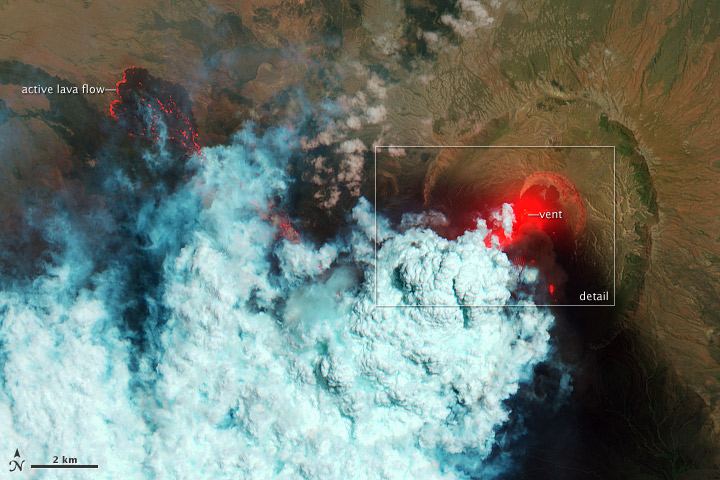
When a volcano erupts, the ash it throws into the sky is usually seen as a disaster, darkening skies, closing airports and burying farms under grey dust. Yet when that ash falls into the sea, it can trigger an explosion of life. Volcanic ash is rich in iron and other minerals that ocean plankton need to grow, and in many parts of the ocean those nutrients are scarce. A large eruption can spread ash across thousands of square kilometres of sea, and within days the water turns green with blooms of microscopic algae feeding on the new nutrients. The blooms feed tiny animals, which in turn feed fish, and researchers have tracked the chain reaction for months after major eruptions. Satellite images have shown vast green patches appearing in the ocean after eruptions in Alaska, the Pacific and the Southern Ocean, each one a burst of growth in waters that were nearly empty before.
What the Evidence Shows
The blooms raise a tempting question: could humans fertilise the ocean deliberately to grow plankton and draw carbon dioxide out of the air? Experiments that scattered iron into the sea did produce blooms, and some carbon sank with the dead plankton to the deep ocean. But the results were modest, and scientists warn that large-scale fertilisation could harm marine life by creating dead zones or shifting the balance of species. The natural eruptions offer a safer way to study the process, since the ocean has absorbed volcanic ash for millions of years without human help. Researchers now rush to eruption sites with ships and sensors, sampling the water as the bloom grows and fades. The work helps them understand how the ocean stores carbon, and how the great eruptions of the past may have shaped the climate of the Earth. Reporting and analysis from sources such as NASA track the same developments, and specialists following volcanic ash feeding ocean life after eruptions say the direction is now consistent across independent lines of evidence.
The Wider Context
Funding bodies are watching volcanic ash feeding ocean life after eruptions closely because the work sits at the junction of basic curiosity and practical return. Grant panels increasingly ask for a path from discovery to application, while researchers push back that the most valuable uses of fundamental science are rarely the ones written into the original proposal. The tension is productive when both sides stay honest about timescales.
What Happens Next
The long view on volcanic ash feeding ocean life after eruptions is that fields advance by accumulation rather than by single announcements. This result adds a solid, checkable piece to a structure many teams are building, and its authors have shared their data so the piece can be tested from every side. That is how the picture eventually becomes reliable enough to act on. You can follow related developments in our coverage of science.
It is also worth remembering how quickly the picture in this area has changed before. Positions that looked settled a few years ago have been revised as new data arrived, and the same humility is appropriate now. The strongest coverage of this subject, and the most useful advice, tends to come from sources that update their views openly when the facts move, rather than defending an earlier position long after it has stopped fitting the evidence available.