

Quick Answer
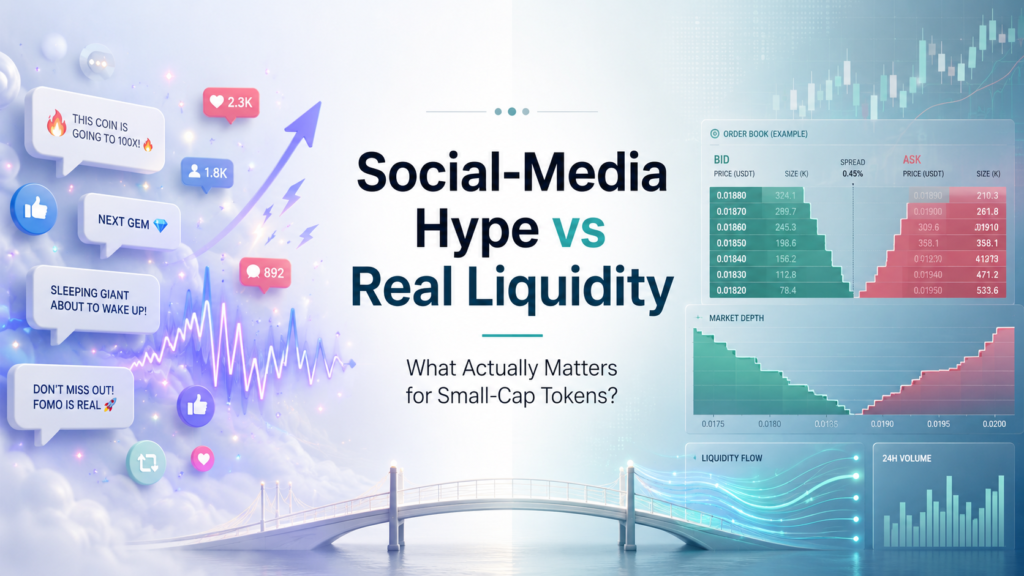
Social-media attention can create demand for a small-cap token, but it says nothing about whether you can actually get out of a position without moving the price against yourself. Before trusting a trending token, check the bid-ask spread, order-book depth at 0.5%–2% from the midpoint, expected slippage at your own order size, and how concentrated the token’s supply is. Volume and follower counts are useful context, not proof of tradability.
Key Takeaways
- Hype measures interest; liquidity measures how much capital can trade near the current price without excessive impact.
- Spread, order-book depth, and slippage at your intended trade size matter more than market cap or 24-hour volume.
- Reported volume can look strong while executable depth stays thin — the two are not the same thing.
- Holder concentration and upcoming token unlocks can quietly erode liquidity even when a chart looks healthy.
- Splitting a position across venues, using limit orders, and testing small trades first reduces execution risk on illiquid tokens.
A token starts trending on X, Telegram, or a community dashboard. Its price and reported volume climb within hours. Traders assume that rising attention means the token has become easier to trade.
That assumption is the problem. Visibility, market capitalization, and headline 24-hour volume do not reveal how much capital can actually enter or exit near the quoted price. Hype can create short-term demand, but real liquidity determines execution quality, trading costs, and whether a trader can leave a position on their own terms. This article evaluates tradability, not which token is likely to rally next.
Does Social-Media Hype Matter If a Token Has Thin Liquidity?
Social momentum can attract buyers, but it does not protect traders from wide spreads, shallow order books, or a lack of counterparties once sentiment reverses.
What attention can genuinely improve:
- Discovery of a token beyond its existing community
- New retail traders and, occasionally, professional market makers
- Steadier order flow that supports better price discovery
- Additional exchange listings or trading pairs if demand persists
Why attention isn’t the same as liquidity:
- Social engagement measures interest; liquidity measures executable buying and selling capacity
- A token can trend while only a small amount of capital sits near the current market price
- Short-term buyers often disappear as soon as the narrative cools
- A rally driven by thin supply can look strong while making both entry and exit more expensive
This is an editorial trade-off worth sitting with: attention can be an early signal of expanding demand, but treating it as proof of liquidity leaves traders vulnerable to becoming exit liquidity for earlier holders. Researchers and regulators have both flagged this dynamic, studies have documented coordinated promotion campaigns and bot-driven engagement around low-cap tokens, and European regulators have identified social media as a heightened channel for misleading crypto information and market manipulation.
Which Metrics Show Whether a Small-Cap Token Is Actually Tradable?
Spread, depth, slippage, and market resiliency show tradability. Follower counts and market capitalization do not.
Bid-ask spread
Bid-ask spread is the difference between the highest bid and lowest ask, usually expressed as a percentage so tokens at different price points can be compared. A wide spread is an immediate cost before fees or price movement even enter the picture, check the live spread, not a daily average.
Order-book depth
It shows how much the market can absorb. Look at cumulative bids and asks within 0.5%, 1%, and 2% of the midpoint. Strong buy-side depth supports exits; strong sell-side depth can cap how far a price can run upward. A large order sitting at one price level can be cancelled at any moment, so it shouldn’t be treated as permanent liquidity.
Slippage
Slippage has to be measured against your own order size, not the market’s. Estimate the average execution price for the trade you actually plan to make, then repeat the estimate at two or three times that size as a stress test. Quoted price and executable price are different things, “enough liquidity” for a $500 order can be entirely insufficient for a $20,000 order.
Resiliency
This is how quickly spreads and depth recover after a large trade. Markets where both sides of the book refill consistently are healthier than markets where volume looks fine but bids vanish the moment price drops.
When Is Social-Media Momentum Useful — and When Is It Mostly Noise?
Momentum is most useful when engagement grows gradually and is followed by sustained participation, deeper markets, and wider distribution.
Signs attention may be organic:
- Growth spread across many independent accounts, not a small influencer cluster
- Discussion of product usage, governance, or development — not only price targets
- Engagement that persists beyond a single announcement
- New attention followed by more active traders, improving depth, narrower spreads, and additional credible venues
Signs hype may be manufactured or temporary:
- Large overnight follower jumps without a comparable rise in unique participants
- Repeated posts using near-identical wording, images, or price targets
- Coordinated influencer posting without disclosed relationships
- Engagement concentrated in giveaways or referral campaigns
- Social mentions rising while spreads widen or buy-side depth declines
- Promotion peaking right before a token unlock, listing, or insider distribution
Treat social data as context, not as an investment signal. Rising mentions or sentiment alone should never be read as a bullish confirmation.
How Can Traders Determine Whether Reported Volume Is Real and Durable?
Reliable volume is consistent over time, supported by visible depth, and spread across multiple credible venues at similar prices.
Twenty-four-hour volume measures trading activity, while depth shows how much can actually trade near the quoted price. High volume with shallow depth is a warning sign.
Also check how concentrated volume is. Liquidity spread across multiple venues is generally more resilient, while concentration on one exchange increases platform and delisting risk.
Finally, compare current activity with 7-day and 30-day averages, see whether volume persists after social-media attention fades, and watch for persistent price differences across exchanges. Volume spikes without matching order-book depth deserve extra scrutiny.
Why Do Circulating Supply, Holder Concentration, and Unlocks Affect Liquidity?
An order book should be evaluated alongside token supply and ownership. A low circulating supply can amplify both rallies and sell-offs, while market cap based on the last traded price may overstate realizable value.
When reviewing large wallets, separate exchange, bridge, treasury, market-maker, and vesting wallets from freely tradable holdings. Also compare circulating, total, and maximum supply, and check upcoming unlocks. Well-managed emissions can support growth, while poorly absorbed supply often increases sell pressure and weakens effective liquidity.
How Should Traders Compare Venues and Execute a Small-Cap Token Trade?
Choose a venue based on the liquidity available for your intended order size — not simply because the token happens to be listed there.
| Factor | Centralized Exchanges (CEX) | Decentralized Exchanges (DEX) |
| Custody | Exchange holds funds | Self-custody |
| Order types | Limit orders, visible order book | Typically swap-based, pool-driven pricing |
| Spreads | Often tighter on liquid pairs | Can widen with pool depth and price impact |
| Transparency | Order book visible, but venue-controlled | Pool reserves publicly visible on-chain |
| Key risks | Custodial exposure, withdrawal suspensions, delisting | Pool fragmentation, gas/routing costs, MEV exposure |
| Best suited for | Traders who want limit orders and stablecoin pairs | Traders prioritizing self-custody and on-chain settlement |
Why market cap and volume do not equal order-book depth: As of August 6, 2026, CoinGecko showed ULTIMA with a market cap of about $205 million and $6.3 million in 24-hour volume. Yet on MEXC’s ULTIMA/USDT market, order-book depth within 2% of the midpoint was only about $13,400 on the ask side and $33,800 on the bid side, despite roughly $431,000 in pair volume. This shows that headline market cap and volume don’t guarantee executable liquidity. Anyone considering trade ULTIMA/USDT should look beyond headline market cap and volume by comparing actual order-book depth, holder concentration, and realistic exit liquidity.
To reduce execution risk generally:
- Use limit orders instead of unrestricted market orders
- Split larger trades into smaller pieces
- Avoid chasing a rapidly moving book
- Add spread, slippage, fees, and withdrawal costs to the true cost of the trade
- Confirm deposits and withdrawals are working before committing size
- Test a small order and withdrawal first
Decision Framework: The Nine-Point Liquidity Check
- Is the bid-ask spread acceptable for your planned holding period?
- Can the visible book absorb your intended order within an acceptable price range?
- What is the estimated slippage at one, two, and five times your planned size?
- Is comparable liquidity available on more than one credible venue?
- Are prices aligned across those venues?
- Has volume stayed consistent beyond a single social-media cycle?
- How concentrated is the liquid (sellable) token supply?
- Are major unlocks, emissions, or treasury transfers approaching?
- Are deposits, withdrawals, and your chosen order type fully operational?
Reading the result:
- Proceed cautiously — depth exceeds your position size, spreads are stable, and liquidity is distributed across venues.
- Reduce position size — liquidity is usable but dependent on a single venue or market maker.
- Avoid the trade — social mentions are rising while spreads widen, depth disappears, or concentrated holders face an approaching liquidity event.
Conclusion: Liquidity Is the Constraint That Hype Cannot Remove
Attention may explain why traders show up to a token, but liquidity determines the price at which they’re able to leave. Evaluate every token at your actual position size, not at the size implied by its market cap. As a working hierarchy: use social momentum for discovery, market structure for verification, and executable liquidity for the final decision.
FAQ
Is high trading volume the same as good liquidity?
No. Volume measures trading activity, while liquidity measures how easily orders can execute with minimal slippage.
What bid-ask spread is acceptable for a small-cap token?
There is no fixed threshold. Wider spreads matter more for short-term trades because entry and exit costs are paid twice.
Can a token have different liquidity across exchanges?
Yes. The same token may have deep liquidity on one exchange and very little on another.
Does social-media sentiment predict liquidity?
Not reliably. It may influence liquidity but shouldn’t be used as a standalone signal.
How often should liquidity be checked?
Immediately before trading, since spreads and order-book depth can change within minutes.