

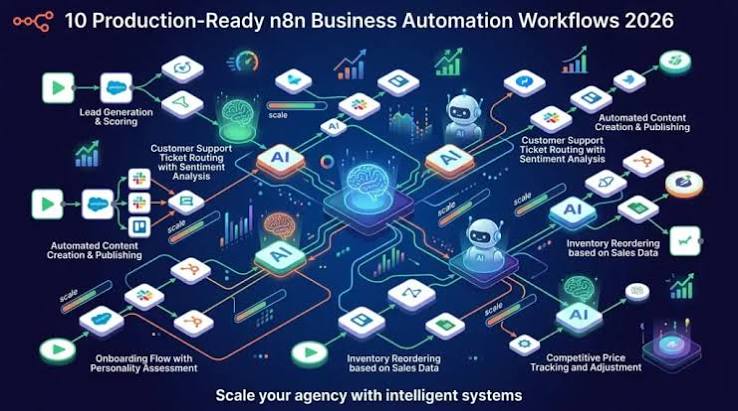
For years, “workflow automation” meant either a rigid SaaS tool that did one thing well, or a custom integration project that ate two quarters of engineering time. In 2026, most companies have found a third path: n8n paired with large language models. It has quietly become the default stack for turning messy, human-heavy processes into reliable automated ones, and the reason is practical, not hype.
Why n8n Plus LLMs Became the Default
n8n is an open-source workflow automation platform. You can self-host it, which matters when your data can’t leave your infrastructure for compliance or client-confidentiality reasons. It connects to hundreds of tools out of the box: CRMs, help desks, databases, Slack, email, payment systems, and any service with an API. When there’s no prebuilt node, you drop in an HTTP request or a snippet of code and keep going.
On its own, n8n is a strong integration engine. What changed the game was wiring language models into the flow. Older automations could only move structured data from A to B. They broke the moment a task required judgment: reading a support email and deciding its urgency, pulling the key terms out of a contract, or writing a first-draft reply. LLMs handle exactly that fuzzy, language-shaped middle layer. n8n handles the plumbing around it: triggers, routing, retries, and delivery.
The combination is cheaper than the alternatives on both ends. It’s far less expensive than rebuilding processes as bespoke software, and self-hosting sidesteps the per-task pricing of closed automation platforms that punishes you as volume grows.
Real Workflows Teams Are Running
The value shows up in specific, unglamorous processes that used to consume hours of staff time. A few that come up again and again:
- Lead capture to CRM enrichment to routing. A form submission triggers the flow. An LLM cleans and standardizes the input, an enrichment API adds company size and industry, and the record lands in the CRM already scored and assigned to the right rep, with a Slack ping to that rep.
- Support ticket triage and drafting. Incoming tickets are classified by topic and urgency, tagged, routed to the correct queue, and given an AI-drafted reply that a human reviews and sends. Response times drop without giving up the human check.
- Content repurposing pipelines. One long asset, such as a webinar transcript or a blog post, becomes a set of social posts, an email summary, and internal talking points, each shaped for its channel, then queued for approval.
- Internal data sync and alerts. Records stay aligned across billing, CRM, and analytics tools, and the team gets a plain-language heads-up when something needs attention: a churned account, a stalled deal, a spike in errors.
None of these are moonshots. They’re the recurring, mid-value tasks that quietly drain a team’s week, and they’re exactly where automation pays back fastest.
Build vs. Buy, and Where Teams Actually Get Stuck
The old build-versus-buy question has softened. With this stack you’re mostly assembling rather than building from scratch or accepting a rigid off-the-shelf product. You get the flexibility of custom work at a fraction of the cost, and you own the logic instead of renting it.
The catch is that “assembling” still requires real skill. This is where most teams stall. Getting a demo workflow to fire once is easy. Building an automation that handles edge cases, retries failed API calls, respects rate limits, keeps credentials secure, doesn’t hallucinate its way into sending a wrong reply, and keeps running when a connected tool changes its API is a different discipline. It sits between backend engineering, prompt design, and operations, and few people cover all three well.
So the real bottleneck in 2026 isn’t the tooling. n8n is mature and the models are capable. The constraint is finding someone who can design these systems properly and, just as important, maintain them once they’re live. Automations are not set-and-forget. APIs shift, business rules evolve, and prompts need tuning as edge cases surface.
The Practical Move: Get the Right Builder
This is why a growing number of ops leaders and founders are choosing to add automation capacity to their team rather than hand it to an agency by the project or hope an existing engineer squeezes it in around their real workload. Bringing in a specialist who builds these automations as a dedicated member of your team means the person who ships the first workflow is the same one who monitors it, improves it, and builds the next ten with full context on how your business runs.
The economics make this straightforward. An offshore automation specialist through a model like AdSnipper starts around $15 an hour, roughly $2,400 a month, versus the $12,000 to $14,000 a month a fully loaded US in-house hire can cost. That’s a 70 to 80% difference for the same output, and it turns automation from a one-off experiment into an ongoing capability your team actually owns.
The Takeaway
n8n plus LLMs has become the practical automation stack for a simple reason: it’s flexible, self-hostable, connects to nearly everything, and costs far less than rebuilding processes as software. The workflows that deliver the fastest return are the boring, repetitive ones, lead handling, ticket triage, content repurposing, data sync. The technology is ready. The differentiator now is having a builder who can implement these reliably and keep them running as your business changes. Companies that solve the talent side, not just the tooling side, are the ones turning automation from a nice demo into real, compounding leverage.